Custom Hair System OEM & ODM Specifications | Ruit Hair
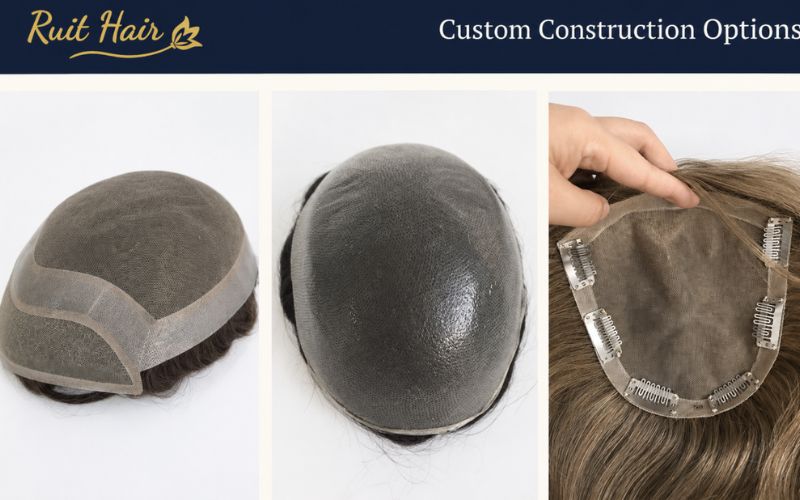
For a wholesaler, customization means building a product range that customers can recognize and reorder. For a factory, it means turning those requirements into a clear, repeatable production specification.
The most productive custom hair system OEM and ODM projects connect both goals. A distinctive product is useful only if its construction suits the wearer and the factory can reproduce the approved result.
From our perspective at Ruit Hair, the starting point is not simply “Can you make this?” It is “Which details matter to your market, and how will we confirm them?”
OEM and ODM: Agree on the Scope First
In a typical sourcing arrangement, OEM means the buyer provides the design or detailed specification and the manufacturer produces to it. ODM involves more supplier design input, often starting from an existing construction that is developed or adapted for the buyer.
In hair systems, the boundary can overlap. A wholesaler might choose an established base and request different dimensions, density, colors, and branding. Another buyer might submit a template, reference unit, and detailed construction drawing.
The label alone does not define the agreement. Confirm who develops the specification, approves samples, pays development costs, and controls any agreed design exclusivity. Private labeling by itself does not make a product design exclusive.
1. Base Design, Size, and Shape
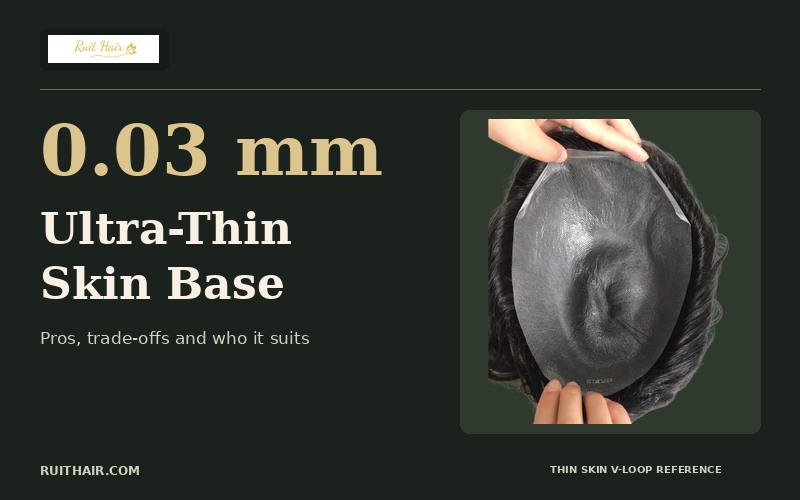
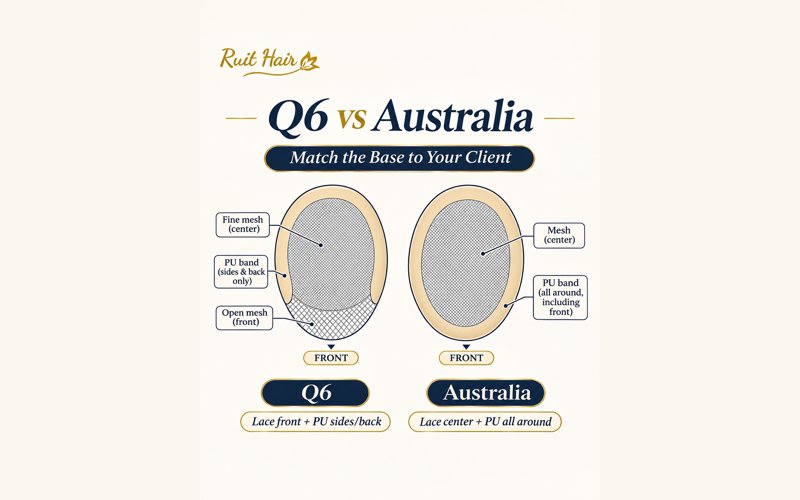
Base construction is one of the most important customization decisions. Options to discuss can include lace, polyurethane skin, monofilament, and combinations with different perimeter or front sections. Availability depends on the proposed design.
Specify finished width and length, front contour, coverage area, curvature, and the placement of any reinforcement or attachment areas. Full wigs need a more complete set of head measurements; a topper needs a base suited to the intended coverage.
For a factory, a marked drawing or physical template can resolve questions that two measurements leave open. For a wholesaler, a consistent base design can simplify product descriptions, fitting advice, and repeat orders.
2. Hair Material and Processing
Confirm the hair material being quoted, including whether the specification calls for human hair, synthetic fiber, or a blend. Ask about processing and the meaning of any terms used to describe origin, cuticle condition, or hair grade.
Descriptions such as “Remy,” “virgin,” or “European” should be supported by a clear explanation. They do not replace a representative sample or establish every aspect of performance.
Material choices must also work with the requested color, texture, length, and construction. These decisions affect the production proposal and price.
3. Color, Highlights, and Gray Distribution
Color customization can involve an overall shade, a blend of shades, highlights, rooted effects, or gray hair, where technically available.
Use a physical color reference when practical. A color code from another supplier may not describe the same shade, and screen images can change the apparent tone.
For gray blends, specify the percentage and where it should appear. A uniform blend differs from concentrated gray at the temples. Wholesalers should keep the approved reference with the item code so future orders use the same benchmark.
4. Density and Its Distribution
A density request should describe more than a single number. The front, top, crown, sides, and back may need different levels of fullness.
Do not assume that “100% density” looks identical across suppliers. Agree on the intended appearance using the factory’s reference and an approved sample.
The factory should assess whether the requested density suits the base and hair length. Wholesalers can then build a focused range of density options rather than offering combinations that have not been evaluated.
5. Hair Length, Wave, Curl, and Direction
Specify length by area if it varies, and agree on how it will be measured. For wavy or curly hair, clarify whether the measurement is taken with the strand extended or in its resting shape.
Texture requests may include straight hair, a gentle wave, or a defined curl. Use a physical sample or an agreed reference rather than relying only on terms such as “body wave.”
Also discuss hair direction: freestyle, a defined part, forward movement, or crown placement. These details should be confirmed separately from the final salon haircut.
6. Hairline and Ventilation Details
Depending on the base, discuss the front-density transition, knotting or other attachment technique, and whether knot treatment is appropriate.
Not every method works with every material or color. A request for a very delicate front, high density, and easy handling may involve tradeoffs that need sample evaluation.
Ask the factory to explain the proposed construction. For wholesalers, accurate descriptions are more useful than promising an “invisible” hairline in every setting.
7. Attachment Features and Brand Presentation
Clips, attachment tabs, perimeter areas, or adjustable cap features may be considered where the construction supports them. Confirm placement and the intended wearing method.
Brand requirements can include labels, item codes, care inserts, packaging, or barcodes, subject to the supplier’s capabilities and order conditions. Confirm these separately from product customization, including artwork, cost, and minimum quantities.
Turn Custom Options into a Reorderable Product
For wholesale purchasing, more variations are not always better. Each extra combination of size, shade, length, and density adds another item to forecast and manage.
Start with a defined core range and use sampling to evaluate new combinations. Before production, approve a specification sheet and reference sample, identify acceptable tolerances, and confirm inspection and after-sales arrangements.
A useful inquiry includes the product type, base drawing or template, material request, color reference, density by area, length, texture, hair direction, attachment details, packaging needs, order quantities, and destination.
Develop Your Custom Hair System Project with Ruit Hair
Ruit Hair welcomes product discussions with salons, wholesalers, distributors, and hair replacement brands. Share your existing specification or explain the customer need behind a new product.
We can discuss relevant options and clarify what needs sample confirmation. OEM or ODM scope, technical feasibility, pricing, minimum quantities, branding options, and delivery schedules should be agreed for the specific project before ordering.
The aim is a product that your customers understand, your team can sell accurately, and your supplier can reproduce against an approved reference.