Swiss Lace vs French Lace: A Wholesale and Salon Guide
Stock Swiss lace when your repeat buyers prioritize an exposed hairline and a fine mesh. Stock French lace when they regularly ask for a sturdier mesh that is easier for their team to handle. Before deciding which to reorder, check your actual sales by base size, color, density and perimeter layout. A lace label alone tells you little about which finished unit will sell.
Swiss Lace and French Lace at a Glance
Swiss lace is typically finer and softer. French lace generally uses stronger threads and has a firmer feel. Grades vary by supplier. Compare the actual samples in the same shade and similar density, with the same front contour and perimeter layout where possible.
| Buying Question | Swiss Lace | French Lace |
|---|---|---|
| When should I sample it first? | When the client wears the hair swept back or wants a finer-looking exposed edge. | When the salon values a sturdier mesh for routine fitting and maintenance. |
| What should the stylist check? | Check how the exposed edge, mesh color, knots and front density look in daylight. | Check edge feel, appearance and handling in the salon’s usual service routine. |
| What should the buyer confirm? | The exact mesh grade, tint, front finish and knot treatment. | The exact mesh grade, perimeter construction, supported density and front finish. |
| What matters for comfort? | Both are open mesh. Compare the fitted base, coverage, bonding area and how the wearer feels in the unit. | |
How Wholesalers Can Build an Opening Stock Range
Start With a Matched Sample Pair
Order one comparable sample of each lace. Match base dimensions, hair color, gray blend and density as closely as the constructions allow. Use the same room, light and viewing distance. If one unit has a different front or PU border, note that difference before attributing the result to lace.
Put Depth Behind Repeat Orders
Review the last 60–90 days of orders and inquiries. Group them by shade, finished size, density, lace and perimeter. Record actual stockouts and requests you could not fill as well as confirmed sales. Hold more stock in the combinations repeat buyers actually reorder. Keep an unfamiliar version at sample depth while you test demand. Set reorder points after confirming lead time and minimum order terms with the supplier.
Opening Stock Worksheet
| Record | Use in Your Decision |
|---|---|
| SKU specification | Record lace grade, coverage, PU layout, finished size, shade, gray blend and density. |
| Demand evidence | Record confirmed orders, stockouts and unfilled requests over the same 60–90 day window. |
| Sample approval | Record daylight appearance, handling feedback and maintenance notes. |
| Stock decision | Choose repeat stock or sample only. Confirm supplier lead time before setting a reorder point. |
Keep Full Lace, Lace Front and PU Layout Separate
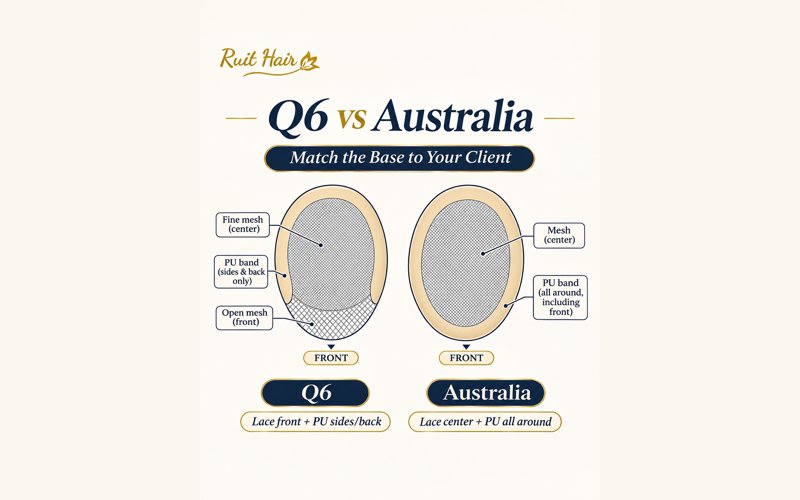
Specify where the lace sits and where the salon can bond. A full-lace unit, a lace front and a lace center with a PU perimeter can fit different service routines. The Ruit Hair Q6 and Australia comparison illustrates two PU layouts. It helps buyers compare perimeter design separately from mesh type.
What a Salon Can Say to a Client
“Swiss lace usually feels finer. If you like wearing your hair off your forehead, let’s check that edge in daylight. French lace generally feels a little firmer and is worth trying if you want a sturdier base for regular maintenance. Let’s see how both look with your hairstyle and how they feel on you.”
Then ask who will remove and clean the unit, whether the client wears the front exposed, and what they value most at their first fitting. Compare both samples under the same light. Confirm lace tint, hairline density, fit and bonding areas before making a recommendation. Discuss expected wear for the approved build rather than promising a fixed lifespan from the lace name.
What to Put on the Sample Request
Base: Lace type and zone, finished length and width, front contour and PU placement or width if applicable.
Hair: Shade, gray blend, target density and desired ventilation or knot finish at the front.
Evaluation: Who will fit and service the unit, which features to compare and what will trigger a reorder.
Use Ruit Hair’s sample inspection checklist to log approval. Contact Ruit Hair to discuss a matched lace sample pairand confirm available constructions before setting your opening assortment.