How to Choose a Reliable Hair System Manufacturer | Ruit Hair
Choosing a hair system manufacturer is a decision about your future customer experience. A sample may look impressive, but salons, wholesalers, and hair replacement brands also need repeatable specifications, realistic delivery information, and a clear response when an order needs attention.
From a factory’s perspective, a successful supply relationship begins with requirements that both sides understand. From a buyer’s perspective, reliability becomes visible when the supplier can explain its work, document the agreed product, and follow through on the order.
Here is a practical approach to evaluating a hair system manufacturer before building a long-term partnership.
1. Define Your Product Requirements Before Comparing Suppliers
Start with the customers you serve. A salon ordering individual men’s systems may have different priorities from a wholesaler supplying women’s toppers or a brand developing full wigs.
Prepare a short sourcing brief covering product type, base construction, dimensions, hair color, length, density, texture, and intended order quantities. Include the hairstyle and attachment requirements where relevant.
Use the same brief when requesting quotations. Without it, two suppliers may quote products that look similar in photographs but differ in materials, construction, or finishing. “Premium quality” is too broad to serve as an agreed specification.
2. Confirm Who Will Manufacture and Supply Your Order
Ask for the supplier’s registered business name, business address, production location, and role in the order. Clarify which operations are carried out directly and which involve production partners.
If you are sourcing from China, request the registered Chinese company name and business registration details so the identity can be checked against official records. Registration confirms information about the business; it does not establish the quality of a particular hair system.
A live video walkthrough or an arranged factory visit can help you understand the relevant work. Ask to see processes connected to your product, such as base preparation, ventilation, finishing, or inspection. A factory tour is one part of evaluation and should be considered alongside samples and order records.
3. Ask Specific Questions About Hair and Base Construction
A reliable discussion should go beyond photographs and broad material labels.
For hair, ask what the supplier means by terms such as Remy, virgin, or European hair. Clarify the claimed origin, processing, coloring, and any limitations relevant to your intended services. These terms should be explained rather than treated as interchangeable guarantees.
For the base, confirm the construction, dimensions, perimeter design, and measurement method. Where thickness matters, ask how it is specified and checked. Discuss ventilation, hair direction, and hairline requirements in relation to the selected base.
Clear technical answers help you judge whether the supplier understands the product you need. They also give you a basis for checking what arrives.
4. Evaluate a Sample Against Written Criteria
Order a sample that represents what you intend to sell. Check it against the agreed specification rather than judging only softness, shine, or the first unboxing impression.
Review base dimensions and shape, color match, density distribution, hair direction, hairline finish, and visible construction. Where practical, use a physical color reference and assess appearance under consistent lighting.
With the supplier’s care instructions, evaluate handling, washing, and styling appropriate to the product. Record your observations and any changes requested. A brief evaluation can reveal useful information, but it cannot establish the full service life of every future unit.
If the sample is approved, retain its order reference and specification. Keep the physical unit or clear reference photographs where appropriate.
5. Find Out How the Manufacturer Controls Repeat Orders
For wholesale buyers, consistency is often more valuable than an exceptional first sample.
Ask how approved specifications are stored, how production changes are communicated, and which checks are performed before dispatch. Discuss acceptable tolerances for measurable features and how subjective features, such as color or density appearance, will be compared.
Ask what happens if a material or construction needs to change. Agree that relevant changes should be discussed before substitution.
Hair systems involve materials and handwork that can vary. The useful question is how the manufacturer identifies variation, decides whether a unit meets the order, and handles an item that does not.
6. Compare Complete Quotations and Delivery Arrangements
A useful quotation identifies the product specification, quantity, unit price, and included services. It should also clarify packaging, sample charges, customization costs, and shipping arrangements where applicable.
Confirm the minimum order quantity for stock and custom products, as well as any separate branding or packaging requirements. At Ruit Hair, stock and custom hair systems start from 1 piece; project details and additional requests still need confirmation.
Separate production time from transport time. Ask when the production estimate begins, what information or approval is needed, and whether the quoted stock variation is actually available. Plan salon appointments around confirmed order progress rather than a general website estimate.
7. Review Communication and After-Sales Procedures
Use the sample order to assess how the supplier communicates. Does the contact answer detailed questions, confirm revisions in writing, and explain limitations clearly?
Before placing a larger order, ask how to report a concern, what evidence is needed, and which time limits apply. Clarify how inspection, alterations, wear, and care may affect the applicable policy. Agree how any proposed repair, replacement, credit, or other resolution will be assessed.
Written terms are more useful than a general promise of “full after-sales support.” Keep the approved specification, quotation, and relevant correspondence together so both sides can refer to the same information.
8. Treat Certifications and Marketing Claims as Items to Verify
If a supplier presents a certificate, audit report, or test report, ask for the issuer, date, named business, location, and scope. Check the claim with the issuing organization where possible.
A company-level assessment does not automatically establish the quality of every product. A report covering one material or model should not be assumed to cover an entire catalog.
Request supporting information for sourcing and processing claims that matter to your business. A supplier’s willingness to explain the limits of its evidence is useful when deciding what you can accurately tell your own customers.
9. Start with a Controlled Order and Review the Result
Once the sample and terms are agreed, place an initial order sized to your business needs. Assess the delivered products, packing, documentation, timing, and response to any concerns.
Before expanding purchases, review whether the order matched the agreed requirements and whether your customers’ feedback suggests any adjustments. Keep an updated specification for each product you intend to reorder.
For a salon, this may mean refining a client’s next unit. For a wholesaler, it may mean narrowing the range to a few products that can be explained, inspected, and reordered consistently.
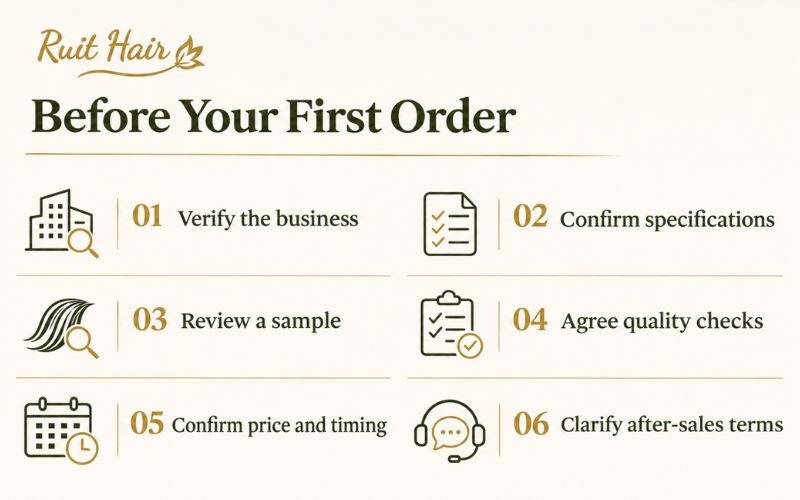
Questions to Ask Before Your First Order
Which company will invoice and supply the goods, and where will production take place?
Can you confirm the full product specification and provide a representative sample?
How are approved specifications, tolerances, and production changes recorded?
What is included in the quotation, and what starts the production timeline?
What is the procedure if the delivered product does not meet the agreed specification?
Build the Relationship Around Evidence and Clear Specifications
A reliable hair system manufacturer should be evaluated through the product, the order process, and its response over time. Clear specifications and a carefully reviewed first order give you a stronger basis for choosing a supply partner.
Ruit Hair works with buyers sourcing men’s and women’s hair systems, toppers, and wigs. With stock and custom orders starting from 1 piece, you can begin by evaluating a product or discussing an individual requirement. Share your sourcing brief with us to confirm suitable specifications, availability, pricing, and order arrangements.